
The Ultimate Guide to Wisconsin Marriage Licenses
Everything you need to know before saying "I do" in Wisconsin.
Planning a wedding comes with hundreds of decisions, but Wisconsin marriage licenses are one detail you simply can't afford to overlook. Without a valid marriage license, your dream wedding may be beautiful—but it won't be legally recognized.
I'm Erika, the owner of Northwoods Event Services, and as a Wisconsin wedding coordinator, I've helped couples navigate everything from vendor logistics to timeline disasters and last-minute emergencies. One thing I've learned? The legal side of getting married often causes the most unnecessary stress because couples assume it's simpler than it actually is.
I've had couples ask me:
"Can we get our license in a different county?"
"Can we apply online?"
"Do we really need two witnesses?"
"Our officiant said they'll file everything... should we double-check?"
The answer to all of those questions is yes, no, maybe, and absolutely.
That's exactly why I created this guide.
Rather than sending you to five different county websites and trying to decode Wisconsin statutes, I've gathered everything you need into one easy-to-follow resource. Throughout this guide, I'll explain the process, share the mistakes I see couples make most often, and offer practical advice from the perspective of someone who coordinates Wisconsin weddings for a living.
While I always encourage couples to verify details with their county clerk as procedures and fees can change, this guide is designed to help you understand the process before you ever step foot in the courthouse.
By the end of this article, you'll know:
Where to apply for your Wisconsin marriage license
Which documents to bring
How much it costs
When to apply
Who can legally marry you
What happens after your ceremony
How to avoid common mistakes that can delay your marriage
Let's start with the basics.
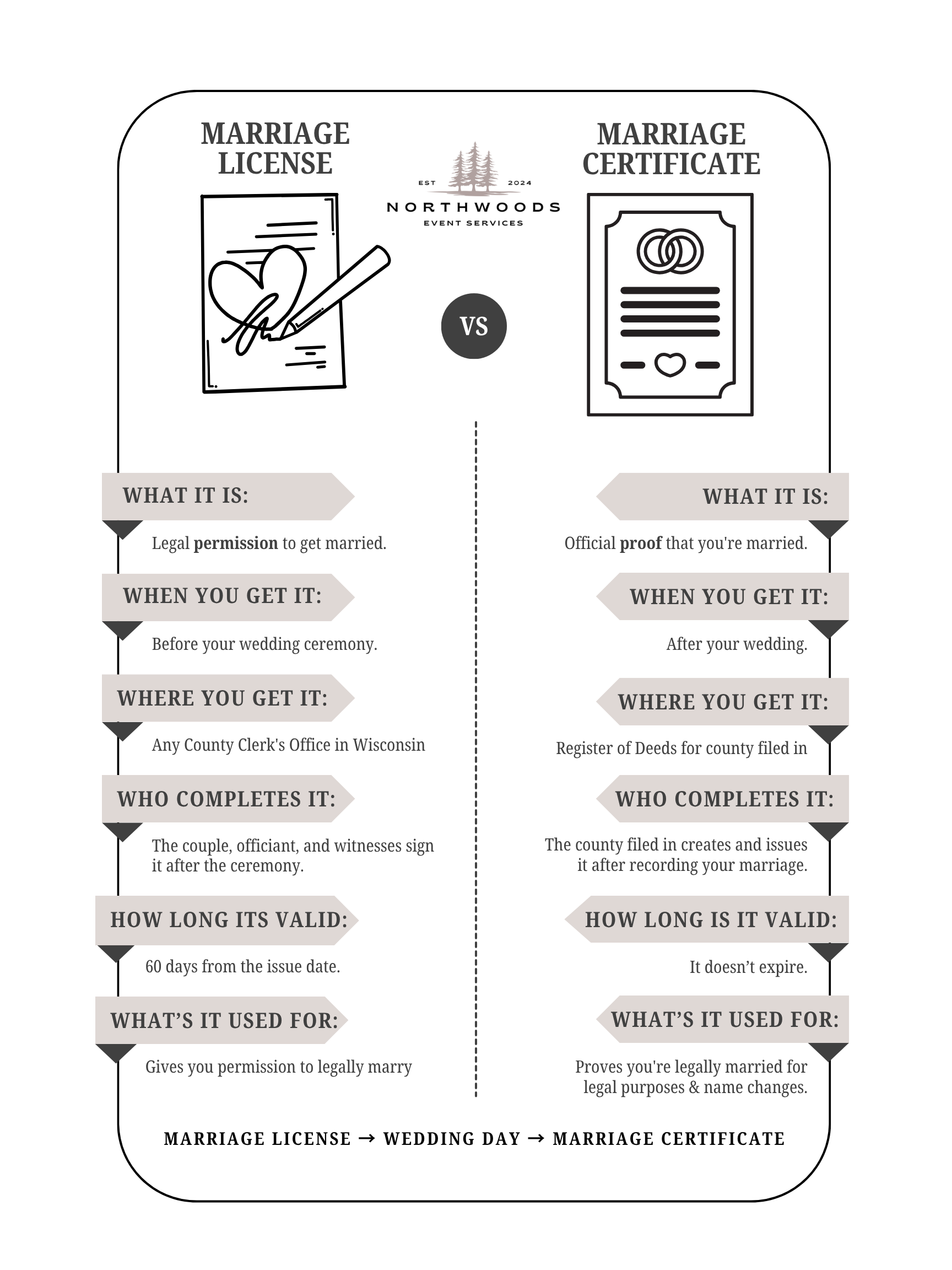
Wisconsin Marriage License vs. Certificate
One of the biggest misconceptions I hear is people using marriage license and marriage certificate interchangeably.
They're actually two different documents.
A marriage license gives you legal permission to get married.
A marriage certificate is the official record proving you are married after your completed marriage license has been filed with the county.
Think of it this way:
Apply for your marriage license.
Get married.
Your officiant files the completed paperwork.
The county records the marriage.
You order certified copies of your marriage certificate.
It sounds straightforward (and it usually is) but only if you know the deadlines and requirements ahead of time.
Wisconsin Marriage Laws
Marriage laws in Wisconsin are governed under Wisconsin Statutes Chapter 765, which outlines everything from eligibility requirements and waiting periods to who can legally officiate a wedding and how your completed marriage license must be filed.
Don't worry - you don't need to read legal statutes to get married. I'll translate the important parts into practical information throughout this guide so you know exactly what applies to your wedding. & The good news? Getting a Wisconsin marriage license is more flexible than many couples realize.
Coordinator Tip: When you hire Northwoods Event Services, we're not just there for the wedding day. We help keep your planning on track by confirming important tasks (like securing your marriage license) are completed well before wedding week so you can focus on enjoying the final countdown to "I do."
You Can Apply in Any Wisconsin County
One of the biggest myths I hear is that you have to apply in the same county where you're getting married.
That's not true.
Your marriage license is valid anywhere within the State of Wisconsin, regardless of which county issued it.
Many couples choose the county where they live simply because it's convenient, but you're free to apply anywhere in the state.
This is especially helpful for destination weddings. If you're getting married in Door County but live near Milwaukee, there's no need to drive across the state just to apply.
Both Partners Must Apply Together
Both applicants must participate in the application process.
Depending on the county, this may happen in person at the County Clerk's Office or virtually through Zoom (if offered). Several counties require appointments, so ensure you check the requirements before walking in to the office.
Some Counties Offer Virtual Appointments
Some counties now offer virtual appointments, while others require you to appear in person.
The most notable example is Dane County, which currently conducts marriage license appointments virtually by Zoom. Both applicants must attend the virtual meeting, although they may join from separate locations if necessary.
Virtual appointments have made the process much easier for couples who live out of state and are coming to Wisconsin to get married.
Wisconsin Marriage License Waiting Period
Wisconsin has a 3 to 5 day waiting period after you apply before your marriage license can typically be issued.
Many counties will waive this waiting period for an additional fee (often around $25) if you have extenuating circumstances.
Because every county handles appointments differently, I recommend scheduling your application two to four weeks before your wedding. That gives you plenty of flexibility while keeping your license well within its 60-day validity period.
Waiting until the final week before your wedding creates unnecessary risk. Offices close for holidays, appointments fill up, documents get forgotten, and unexpected issues can arise.
The sooner you take care of it, the sooner you can focus on the fun parts of wedding planning.
Coordinator Tip: Couples often assume they can stop by the courthouse a day or two before their wedding. Depending on your county's waiting period and appointment availability, that may not be possible. Applying early gives you one less thing to worry about as your wedding day approaches.
Wisconsin Marriage License Expiration
Once issued, your Wisconsin marriage license is valid for 60 days. Meaning, your ceremony must take place within those 60 days.
If your wedding is postponed beyond that timeframe, you'll need to apply again and pay a new license fee.
Because of this, I generally recommend applying about one month before your wedding. That gives you plenty of cushion without risking the license expiring if your plans change.
Where You Can Get Married in Wisconsin
Once your Wisconsin marriage license has been issued, your ceremony can take place anywhere within the state during the 60-day validity period (aka. before your marriage license expires).
One of my favorite things about coordinating weddings in Wisconsin is how diverse our venues are. One weekend I might be at a historic downtown ballroom, and the next I'm helping set up chairs overlooking Lake Michigan or deep in the Northwoods.
As long as your ceremony is performed within Wisconsin and follows state law, the location itself is largely up to you.
If you're planning a destination wedding in Wisconsin, make sure you build enough time into your travel plans to complete and return your marriage license appointment before the ceremony.
Choosing Which County to File In
If You & Your Partner Live in Different Counties
No problem if you and your partner live in different counties!
If one of you lives in Green Bay and the other lives in Madison (or one of you even lives outside Wisconsin) you can still apply in any Wisconsin county. The county where you apply does not determine where you can legally marry.
If You & Your Partner Live Out-of-State
Wisconsin is home to countless destination weddings each year.
Whether you're planning a lakeside ceremony in Door County, a Northwoods retreat, or a downtown Milwaukee celebration, out-of-state residents follow the same general application process.
You'll simply apply through any Wisconsin County Clerk before your ceremony. This can include Dane County, where they offer virtual appointments or the county in which you’re getting married. Though, if you're traveling into the state for your wedding, I strongly recommend scheduling your application appointment well in advance and confirming all required documents before you arrive.
Wisconsin Marriage License Offices
While Wisconsin law is consistent statewide, each county sets its own appointment procedures, fees, payment methods, and office policies. That's why it's always worth checking the county's official marriage license page before applying.
In the next section, I'll break down the counties I work with most often - including fees, payment methods, waiting periods, and direct links to each County Clerk's office - so you don't have to search for them yourself.
Wisconsin Marriage License County Office Guide: What to Expect
Now that you know you can apply for your Wisconsin marriage license in any county, let's talk about something many couples don't realize:
Not every county does things the same way.
The state sets the marriage laws, but each county clerk decides things like:
Appointment requirements
Office hours
Marriage license fees
Accepted payment methods
Whether they offer virtual appointments
Whether they'll waive the waiting period
This is one of the reasons I encourage couples to start this process well before their wedding. The last thing you want is to discover your county only accepts cash or that appointments are booked for the next two weeks.
Wisconsin Marriage License Fees by County
Below are some of the Wisconsin counties I work with most often. Since counties can update fees and policies, always confirm the current information on the official County Clerk website before your appointment.
-
Fee: $110
Accepted payment: Cash, debit, and credit cards
Notes: Three-day waiting period may be waived for an additional $25. Appointments are required. -
Fee: $110
Accepted payment: Cash, check, and credit cards
Notes: Also offers courthouse wedding ceremonies. -
Fee: $120
Accepted payment: Cash and debit/credit cards
Notes: 3% convenience fee applies to card payments. No personal checks, American Express, or Chase credit cards. Appointments required. -
Fee: $100
Accepted payment: Cash only
Notes: Exact cash is recommended. -
Fee: $125
Accepted payment: Cash, check, and cards
Notes: Additional fees may apply if you apply close to your wedding date. -
Fee: $115
Accepted payment: County-accepted payment methods
Notes: Waiting period waiver available for an additional fee. -
Fee: $100
Accepted payment: Cash, check, debit, and credit cards
Notes: Card processing fees apply. -
Fee: $100
Accepted payment: Cash or check only
Notes: No debit or credit cards accepted. -
Fee: $80
Accepted payment: County-accepted payment methods
Notes: One of the lower-cost options in Wisconsin. -
Fee: $100
Accepted payment: County-accepted payment methods
Notes: Extremely popular for destination weddings—plan appointments early. -
Fee: $100
Accepted payment: County-accepted payment methods
Notes: Waiting period waiver may be available with approval. -
Fee: $90
Accepted payment: County-accepted payment methods
Notes: Budget-friendly option, especially for Northwoods weddings. -
Fee: $90
Accepted payment: County-accepted payment methods
Notes: Budget-friendly option, especially for Northwoods weddings. -
Fee: $150
Accepted payment: Debit and credit cards
Notes: Marriage license appointments are completed virtually via Zoom.
Official County Websites
I always recommend going directly to your county's official website instead of relying on social media or outdated blog posts.
-
Waukesha County:https://www.waukeshacounty.gov/county-clerks-office/marriage-licenses/
Washington County:https://www.washcowisco.gov/departments/county_clerk/marriage_license
Milwaukee County:https://county.milwaukee.gov/EN/County-Clerk/Marriage-License
Ozaukee County:https://www.ozaukeecounty.gov/163/Marriages
-
Brown County:https://www.browncountywi.gov/services/marriage-license-apply-for-a-marriage-license/
Outagamie County: https://www.outagamie.org/Our-County/County-Clerk/Marriage-Licenses
Winnebago County:https://www.winnebagocountywi.gov/269/Marriage-Information
Waupaca County:https://www.waupacacounty-wi.gov/departments/government_departments/county_clerk/marriage_licenses.php
Manitowoc County:https://manitowoccountywi.gov/departments/county-clerk/marriage-license/
Door County:https://doorcountysheriff.org/434/Marriage-License-Information
Calumet County:https://www.co.calumet.wi.us/745/Marriage-Licenses
-
Virtual Option
Dane County:https://clerk.danecounty.gov/Marriage
Bookmark your county's page early in the planning process. It's the quickest way to verify appointment availability and any updates before your application.
Feeling Overwhelmed by Wedding Planning?
We get it! Between marriage license requirements, vendor communication, timelines, seating charts, and countless to-do lists, it's easy to feel like there's always something to remember. But, you don't have to manage it all on your own!
At Northwoods Event Services, we help Wisconsin couples stay organized, on schedule, and confident - so you can spend less time stressing and more time enjoying.
Ready for a wedding coordinator who keeps everything on track?
→ Explore Our Wedding Coordination Services
Applying for Your Wisconsin Marriage License
Before you schedule your appointment, make sure you have everything you'll need. The most common reason couples have to reschedule isn't because they filled out the application incorrectly it's because they're missing required documentation at their appointment.
Documents You'll Need
Both applicants should be prepared to provide:
Valid Photo Identification
Acceptable forms of identification generally include:
Driver's license
State-issued ID
Passport
Military ID
Your identification should be current and unexpired.
Certified Birth Certificate
You'll also need a government-issued certified birth certificate.
A decorative hospital birth certificate or keepsake certificate isn't accepted.
If you've misplaced yours, give yourself plenty of time to request a certified copy before your appointment.
Social Security Number
Applicants should provide their Social Security number if they have one.
You generally won't need to bring your Social Security card, but you'll need to know your number.
Proof of Residency
You'll also need proof of your current residence.
Examples include:
Utility bill
Bank statement
Lease agreement
Government correspondence
Good news for destination couples: your proof of residency does not have to be from Wisconsin. You can be a resident of another state and still get married in Wisconsin.
Previously Married?
If either of you has been married before, you'll need documentation showing how that marriage legally ended.
That usually means bringing either:
A certified divorce judgment, or
A certified death certificate for your former spouse.
Don't assume a photocopy will be accepted. Most counties require certified documents.
International Couples
If one or both applicants were born outside the United States, you'll typically need:
A certified birth certificate
A notarized English translation if the document isn't in English
Proof of residency from your country of residence
Because document requirements can vary slightly, I always recommend contacting your county clerk before your appointment if either applicant is an international citizen.
Age Requirements
Wisconsin law requires applicants to be at least 18 years old to marry without parental consent.
Applicants who are 16 or 17 years old may marry with parental or guardian consent, provided all legal requirements are met.
Same-Sex Marriage in Wisconsin
Same-sex marriage is fully legal in Wisconsin.
The marriage license process, required documents, waiting periods, fees, and legal requirements are exactly the same for all couples.
Whether you're planning a courthouse ceremony or a large celebration, you'll follow the same application process outlined throughout this guide.
Coordinator Tip: One thing I do during my final planning meetings is verify that couples have already completed their marriage license appointment. It's a simple checkpoint, but it prevents one of the biggest sources of last-minute stress.
Officiants & Information You'll Need
By the time you schedule your marriage license appointment, you should have more than just your personal documents ready. Your county clerk will also ask for details about your wedding itself, so having those finalized ahead of time will make your appointment much smoother.
One thing I always tell my couples is this: don't wait until the week of your wedding to choose your officiant. Your officiant isn't just there to perform the ceremony - they're also responsible for completing an important legal document correctly.
Have Your Officiant's Information Ready
When you apply for your Wisconsin marriage license, you'll typically need to provide your officiant's:
Full legal name
Mailing address
Phone number
Email address
If your officiant changes after you've received your marriage license, don't panic. Contact the county clerk that issued your license to determine if any updates are needed before your wedding day.
Coordinator Tip: If you're hiring a professional officiant, ask them early in the planning process if they routinely complete and return marriage licenses. Most do, but it's never a bad idea to confirm.
Have Your Wedding Details Ready
Your marriage license application will ask where your ceremony is taking place. Make sure you know:
Your wedding date
The Wisconsin county where you'll be getting married
The city, village, or town where the ceremony will occur
If you're getting married at a venue, this information is usually easy to find. If you're planning a backyard wedding, private property ceremony, or another unique location, double-check that you know the correct municipality - not just the mailing address.
One interesting Wisconsin law applies if you're getting married in a moving conveyance, such as on a boat or train. In that case, the place of marriage is legally considered the city, village, or town where you exit the conveyance after the ceremony.
Choosing Your Officiant in Wisconsin
Wisconsin law allows several different people to legally perform marriage ceremonies.
Authorized officiants include:
Ordained members of the clergy
Licensed religious officials serving as clergy
Judges
Reserve judges
Circuit court commissioners
Supplemental court commissioners
Municipal judges
These officiants must generally be at least 18 years old.
Can Someone Ordained Online Officiate My Wedding?
This is probably one of the questions I receive most often.
The answer isn't as straightforward as many wedding websites make it sound.
Wisconsin law recognizes ordained clergy but doesn't specifically address every type of online ordination. Because organizations and circumstances vary, I recommend speaking with both your officiant and the county clerk that issued your marriage license if you have any concerns.
If you've asked a friend or family member to officiate, don't wait until the month before your wedding to verify they're eligible. Giving yourself plenty of time avoids unnecessary stress.
Can We Officiate Our Own Wedding?
Wisconsin is one of the few states where self-solemnization may be permitted - with an important distinction.
State law allows couples to solemnize their own marriage only in accordance with the customs, rules, and regulations of a religious society, denomination, or sect to which either party belongs.
In other words, self-solemnization isn't automatically available to every couple simply because they prefer not to have an officiant.
If you're considering this option, speak with your county clerk well before applying for your marriage license to confirm whether it applies to your circumstances.
Step 1: Apply for Marriage License
The actual application process is usually simple, especially if you've gathered your documents ahead of time.
Here's what you can generally expect.
a. Schedule Your Appointment
Many Wisconsin counties require appointments.
Some offer:
In-person appointments
Virtual Zoom appointments
Limited walk-in availability
Don't assume your county accepts walk-ins. Check their website before making plans.
b. Gather Your Documents
Before leaving home, make sure you have:
✔ Valid photo ID
✔ Certified birth certificate
✔ Social Security number
✔ Proof of residency
✔ Divorce decree or death certificate if previously married
✔ Payment for the marriage license fee (check requirements for your county!)
c. Attend Together
Both applicants generally need to appear together during the appointment.
For counties offering virtual appointments, both applicants must still participate, although they may join from separate locations if allowed by the county.
d. Complete the Application
The clerk will review your documents and ask questions to complete your application.
You'll verify information including:
Full legal names
Dates of birth
Parents' names
Current addresses
Occupations
Wedding date
Ceremony location
Officiant information
Take your time.
Even small spelling mistakes can create headaches later when ordering certified marriage certificates or completing a name change.
e. Take the Oath
Before your marriage license is issued, both applicants will swear or affirm that the information provided is true and accurate.
You'll then sign the application.
At that point, assuming all requirements have been met, your marriage license will either be issued immediately (if the waiting period has been satisfied or waived) or become available after your county's required waiting period.
Step 2: Complete Your License (Wedding Day)
Once your ceremony begins, your marriage license becomes much more than paperwork.
Legally, Wisconsin requires only two specific components during the ceremony itself:
Declaration of Intent – the moment you and your partner each express your consent to marry.
Pronouncement – when your officiant officially declares you married.
While many couples choose to include personal vows, readings, unity ceremonies, or other traditions, these elements are optional. The Declaration of Intent and Pronouncement are the legal requirements that make your marriage valid under Wisconsin law.
Coordinator Tip: At Northwoods Event Services, we meet virtually with any family member or friend who will be officiating your wedding before the rehearsal (if a rehearsal is included in your package). During that meeting, we walk through the ceremony from start to finish, discuss timing and cues, review Wisconsin's legal requirements, and make sure they're comfortable completing the marriage license correctly. This gives first-time officiants the confidence to lead your ceremony smoothly without overlooking any of the legal requirements or important moments that make your marriage official.
Signing Your Wisconsin Marriage License
After your ceremony, your marriage license must be completed and signed before it can be officially recorded.
The following individuals are required to sign the license:
You
Your spouse
Your officiant
Witness #1
Witness #2
Be sure everyone signs in the correct location using black ink, if required by your county.
Your officiant must also complete their section of the marriage license, which typically includes:
Printed name
Signature
Mailing address
Phone number
Email address
Take a few moments to ensure every section is completed accurately before anyone leaves the ceremony. Missing information, signatures in the wrong place, or other errors can delay your marriage from being officially recorded by the county.
Witness Requirements in Wisconsin
One of the easiest parts of the marriage license process is also one of the easiest to forget.
Wisconsin law requires two competent adult witnesses to be present during your marriage ceremony. These witnesses must watch the ceremony take place and then sign your marriage license afterward.
The witnesses must:
Be at least 18 years old
Be mentally competent
Be physically present during the ceremony
The witnesses can be almost anyone and can include family members, friends, wedding party, guests and even your wedding coordinator! (Though I prefer to focus on coordinating the behind-the-scenes of your wedding!)
If one party is serving on active duty in the U.S. Armed Forces, Wisconsin law allows for only one witness instead of two.
Coordinator Tip: I always make sure to know who your witnesses are before your ceremony begins as this helps make sure everyone is present for the completion of the marriage license!
Returning the Marriage License
This is one detail many couples never think to ask.
In most weddings, the officiant is responsible for returning the completed marriage document within 3 days after the ceremony.
Under Wisconsin law, the completed marriage document must be returned promptly after the wedding so it can be officially recorded.
However, don't assume every officiant automatically handles this.
When interviewing officiants, confirm if the officiant will return the completed marriage license to the county after your ceremony.
If you're legally marrying yourselves under Wisconsin's self-solemnization provisions, you (not an officiant) are responsible for returning the completed marriage document within the required timeframe.
Coordinator Tip: During rehearsal, I confirm who's taking possession of the marriage license after the ceremony. It's a tiny detail that's easy to overlook, but having a clear plan ensures the paperwork doesn't accidentally get left behind at the venue.

I’m so glad you’re here!
I'm Erika, and helping Wisconsin couples enjoy their wedding planning process and wedding day is what I do.
I've always been the person who notices the details, makes the plan, and thinks three steps ahead. After years working in emergency services, staying calm when things get busy and finding solutions on the fly became second nature — and as it turns out, those skills transition perfectly into wedding planning and coordination.
Whether you're navigating the planning process or celebrating on your wedding day, my goal is simple: for you to be present, enjoy every moment, and know that the details are being taken care of.
I’d love to be your wedding advocate, helping you navigate the details, solve problems, and enjoy the wedding experience you’ve been dreaming about.
Ready for a little extra support behind the scenes? Learn more about wedding coordination with Northwoods Event Services
Ordering Your Marriage Certificate
Congratulations! Once your completed marriage license has been recorded, you're officially married.
About a week after the document has been filed, you can begin ordering certified copies of your marriage certificate.
You'll need certified copies for changing your name, updating social security and obtaining new documents.
Many Wisconsin counties allow you to order certified copies through online, by mail, in person and through VitalCheck (where available).
I usually recommend ordering 3 certified copies (at a minimum) from the beginning as it's much easier than having to request additional copies months later.
Changing Your Name After Marriage
Getting your marriage license is only the first step.
If you plan to change your last name after your wedding, you'll use your certified marriage certificate to update your legal records.
One resource I frequently recommend is NewlyNamed. They provide personalized name change packets with pre-filled forms, detailed instructions, and helpful checklists that make the process much less overwhelming.
Instead of researching every agency individually, they organize everything into one streamlined system.
Common Mistakes Couples Make
After coordinating weddings throughout Wisconsin, I've noticed the same mistakes happen over and over again.
The good news?
Every single one of them is preventable.
-
The biggest mistake we see is couples overlooking the waiting period and/or assuming that their county will have appointments ready for when they need one.
Wisconsin has a 3 to 5 day waiting period after you apply before your marriage license can typically be issued and while many counties will waive this waiting period for an additional fee (often around $25) if you have extenuating circumstances, it’s best to not count on this.
Additionally, appointments fill quickly, especially during peak wedding season.
Because of this, we recommend scheduling your application two to four weeks before your wedding. That gives you plenty of flexibility while keeping your license well within its 60-day validity period.
-
Keep in mind the waiting period and expiration of your marriage license.
Applying too late causes unnecessary stress while applying too early can be just as problematic if your license expires before your ceremony.
We recommend our couples schedule their application two to four weeks before their wedding. That gives plenty of flexibility while keeping the license well within its 60-day validity period.
-
Make sure you have all of your required documents and that they are not expired.
If any of you identification is expired, ensure to renew this before your appointment.
-
Nothing is more frustrating and stressful than taking time off work only to discover you're missing your certified birth certificate or divorce paperwork and then not being able to reschedule before your wedding.
Make sure to review our checklist of items to bring and for added points, call your Clerks Office before your appointment.
-
Each Wisconsin county has its own fees, appointment system, payment methods, office hours and waiting periods.
Always verify the details with the county issuing your marriage license before your appointment.
-
Always make sure to have a plan for who’s responsible for returning your marriage license.
Ask your officiant one simple question:
"Will you return our completed marriage license after the ceremony?"
Professional officiants almost always do - but don't assume.
-
I've seen couples realize moments before the ceremony that while they have planned who will be their witnesses, they never officially asked them to serve as one.
Choose your witnesses ahead of time and let them know what you'll need.
-
This one surprises couples the most.
Your venue is responsible for hosting your wedding - not your legal paperwork.
Your venue coordinator, caterer, DJ, photographer, florist, or bartender won't make sure your marriage license is complete.
That's one of the many reasons couples hire a wedding coordinator.
While I can't file paperwork for you, I make sure you know exactly what needs to happen, who is responsible for it, and when it should be completed. Those little reminders help prevent small details from becoming major problems.
Wisconsin Marriage License Checklist
Before your appointment, make sure you've completed the following:
✔ Schedule your marriage license appointment.
✔ Confirm your county's fees and payment methods.
✔ Gather valid photo identification.
✔ Obtain a certified birth certificate.
✔ Locate your Social Security number.
✔ Bring proof of residency.
✔ Gather divorce or death records if previously married.
✔ Confirm your officiant and their information.
✔ Know your ceremony date and location.
✔ Decide who your two witnesses will be.
✔ Apply several weeks before your wedding.
✔ Order certified marriage certificates after your wedding.
Frequently Asked Questions
-
Some counties, such as Dane County, offer virtual appointments. Others require you to apply in person. Check with the county issuing your license for its current process.
-
Yes. A Wisconsin marriage license is valid anywhere within the state during its 60-day validity period.
-
Your license is valid for 60 days from the date it's issued.
-
Usually not. Most counties have a three- to five-day waiting period, although some will waive that period for an additional fee if approved.
-
Typically yes, but requirements can vary depending on the circumstances, so it's always best to confirm with your officiant and the county clerk issuing your license.
-
Out-of-state couples may absolutely get married in Wisconsin. You'll simply need to obtain your marriage license through a Wisconsin county before your ceremony.
Final Thoughts
Your marriage license is one of the smallest items on your wedding checklist, but it's also one of the most important. Without it, all the months you've spent planning your celebration won't result in a legally recognized marriage.
The good news is that, with a little preparation, the process is straightforward. Apply within the right timeframe, gather your documents, confirm your officiant, and understand your county's requirements. Taking care of these details early allows you to spend the final weeks before your wedding focusing on what truly matters: celebrating with the people you love.
As a wedding coordinator, I believe my job goes far beyond keeping your timeline on track. I want you to feel confident throughout the planning process, knowing that someone is looking ahead, catching the details you may not even realize need attention, and helping your wedding day unfold as smoothly as possible.
If you're looking for a coordinator who believes that preparation creates peace of mind, I'd love to be part of your wedding day.
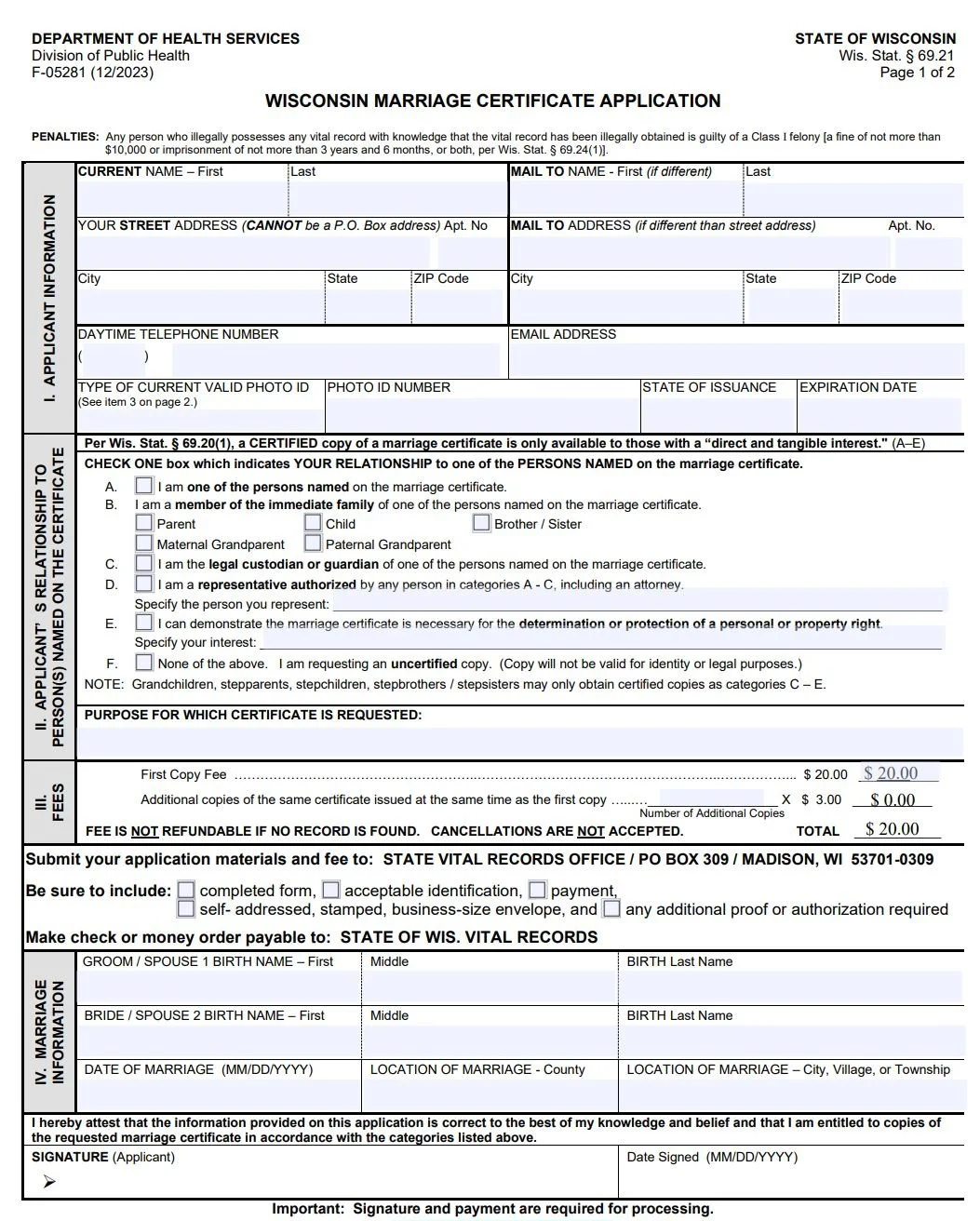
Click image to be brought to form
Ready to make planning easier? Learn more about my wedding coordination services or explore additional wedding planning resources. Whether you're planning a Northwoods celebration, a Door County destination wedding, or a downtown Milwaukee reception, I'm here to help you enjoy the planning process just as much as the wedding day itself.
